
I was in a pub in Ledenhall Market with a group of London lifers last month, chatting about a fantastic trip I took this year run by Moorlands Matters, where a lot of the conversation surrounded the marriage between shooting and conservation, to which they answered, “aren’t those two things a complete contradiction of each other?” Well, I’ll now be sending them all this article…
What's already happening on shoot land

We asked our shoot owners in the 2026 Census, sponsored by Lycetts, about their conservation efforts. Across a decade of our Shoot Owner Census and Game Shooting Census, the answer that comes back is remarkably consistent, shooting and conservation not only co-exist but at times co-depend.
First, we must start with what shoots are doing already. It is evident ,from the data from the annual Census, that shoots are treating conservation work as par for the course, not just ad hoc tickboxing.
Predator control sits above 91% every single year since between 2020 and 2026. During this period woodland management, winter feeding through the hungry gap, and habitat work for game and wildlife have all been carried out by over 75% of shoots.
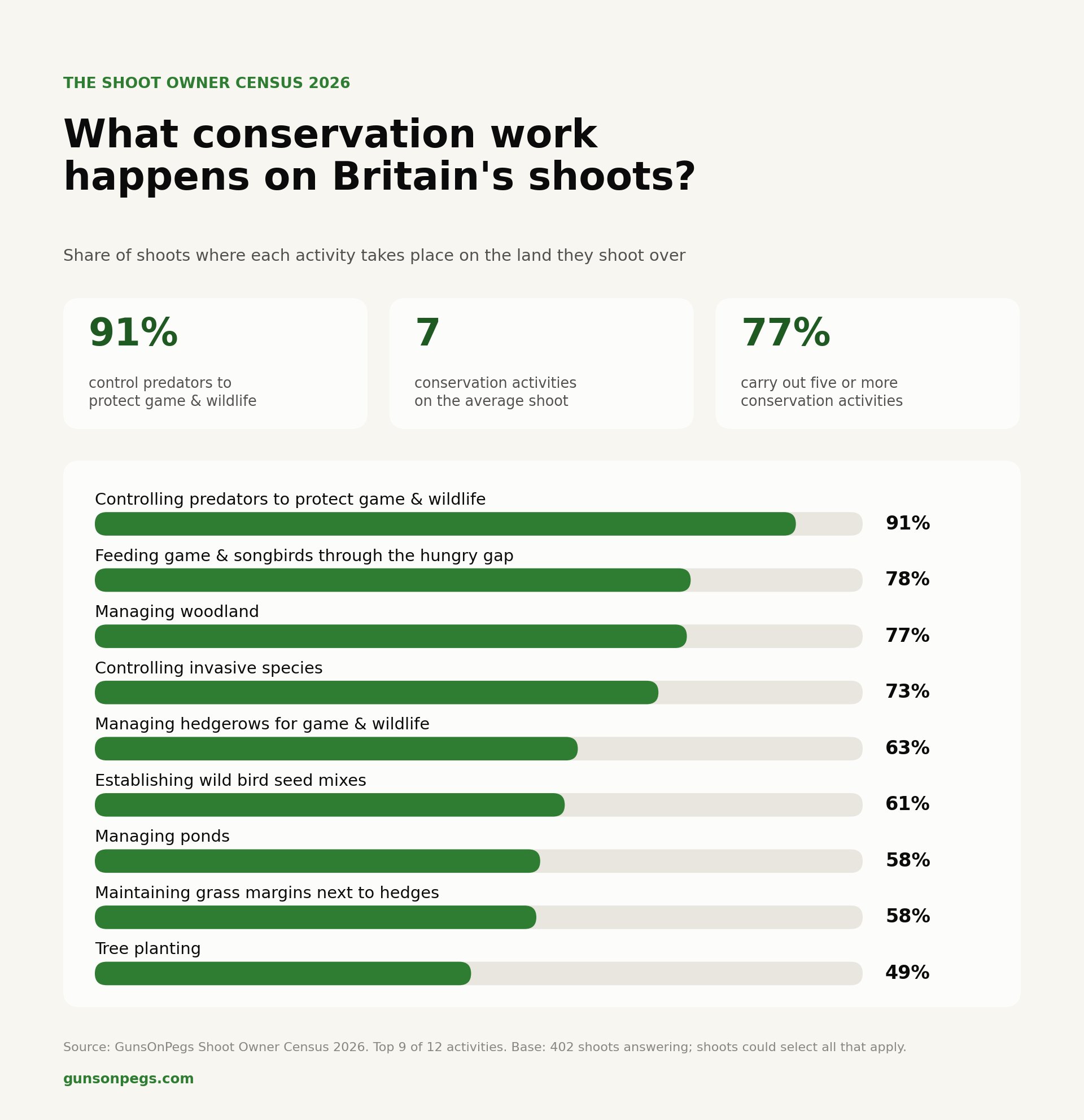
The 2026 Census also welcomed a host of new options to choose from when pointing out conservation work, including hedgerow management (62.9%), wild bird seed mixes (61.2%), pond management (58.0%), grass margins by hedges (57.5%), pollen and nectar mixes (37.3%) and wildflower margins (25.4%).
The question that matters: what if shooting stopped?
This is where it gets interesting. In 2026 we asked whether each conservation activity listed would decrease, and the numbers speak for themselves.
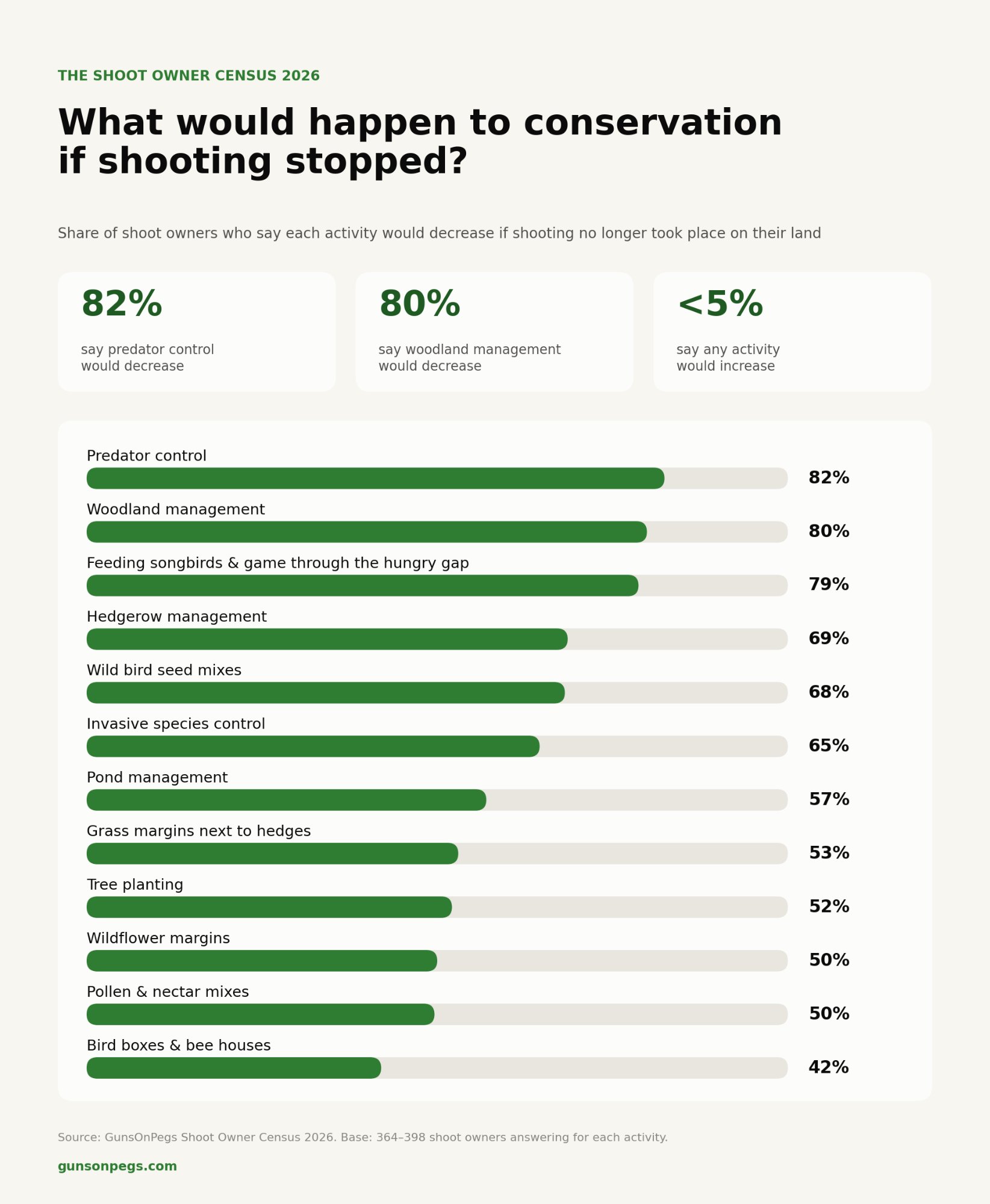
The one number that really stands out here is that across every activity asked about in 2026, fewer than 5% of owners said it would increase if shooting ended. Almost nobody thinks less shooting means more conservation.
The land behind the numbers
The scale of this conservation work is hard to conceptualize looking at these figures, so let’s break it down. The median shoot covers 750–1,000 acres, and in most years the shoots responding to our census between them account for 0.9 - 1 million acres of the country.
On that land, shoots plant a median of 10 - 12 acres of cover crop each, 13,060 acres across 388 shoots in 2026 alone, though 15 - 17% plant none at all.
Shoot Type | Acreage of Wild Bird Seed Planted |
Average Shoot | 19.8 acres average |
Surveyed Shoots | 7,517 acres total |
All Keepered Shoots | c. 69,418 acres total |
All Shoots | c. 218,171 acres total |
Wild bird seed mix covered 7,517 acres across 379 shoots in 2026, up from 6,530 in 2024. This marks the average shoot planting 19.8 acres of wild bird seed. Of course we cannot speak for every shoot in the UK, so these figures come very caveated, however, using these numbers, we can work out that the 3,500 keepered shoots in the UK are planting around 69,418 acres and the 11,000 shoots in the UK plant around 218,171 acres of wild bird seed mix.
Around a quarter of shoots plant new woodland every year (2,626 acres in 2026, 3,015 in 2024), and the woodland actively managed by responding shoots came to 75,463 acres in 2026 alone.
Why are they doing it?
It isn't a side effect they're indifferent to, either. In 2020, 95.9% of shoot owners said they do conservation work at least partly because of shooting 63.1% for both shooting and its own sake, 32.8% purely as a result of shooting, and just 4.1% doing it for its own sake alone.
What the guns say about themselves
It isn't just owners doing the conservation talking, either. Over half of guns (51.7% in 2019) say they carry out conservation work as a direct result of their involvement in shooting.
In 2020, that converted into specifics: 66.5% feed songbirds through winter, 55.8% control predators, 40.5% control invasive plants, 38.9% manage habitat, 34.3% put up bird and bee boxes, 33.6% create nesting cover, 33.4% manage woodland, 32.0% support a conservation charity directly, 31.4% plant trees and 29.4% create wildlife areas - and 71.6% said they'd like to do more.

Not only does the conservation work from the owners rely on shooting to continue at the same rate, shooting is encouraging people to help where they can and take an active interest in understanding how shooting and conservation walk hand in hand.
So, would it survive?
Not vanish overnight based off the 2026 Census, but shrink substantially, and almost across the board.
By shoot owners' own account, predator control, woodland management and winter feeding would all see the sharpest falls if shooting was banned, the very activities that have such a huge impact on endangered species population and biodiversity.
Conservation in the British countryside doesn't begin and end with shooting. But according to the people doing the work on the ground, a very large amount of it currently runs through it.
The Census couldn't happen without our sponsors
Thank you to Lycetts for sponsoring the 2026 Game Shooting Census. Without their support we wouldn't be able to deliver such a comprehensive overview of the game shooting sector.
For over six decades, Lycetts has provided specialist insurance and financial advice to clients across the UK. We combine expertise in commercial, rural, private client and equine with a personal approach, building relationships on trust that last.
For all of your insurance needs, head to Lycetts to see how they can help you.

Comments
Loading comments…
Post a comment
to post a comment.